

Harnessing Social Stories to Enrich Montessori Learning Experiences

Updated: Feb 8

I still remember a training session at Seton Montessori Institute, where our instructor, the insightful Beth Norman, shared a simple yet powerful resource that would shape my teaching approach for years to come. She recounted her practice of taking children on field trips to The Art Institute of Chicago, always starting the journey with a handmade story to introduce the museum. This practice wasn’t about convenience or complexity; it was about fostering a genuine connection.
Beth shared that the children became oriented to the space ahead of each trip. They understood what the trip would look like, how to move through the space, what was expected of them, and how they would feel once they arrived.
She didn’t call it a “social story.” She didn’t need to. But that moment quietly shaped how I think about preparing young children for the world—and it’s something we now use constantly in our Montessori classroom.
Why social stories matter (especially for young children)
Social stories are short, concrete narrative, often paired with real photo,
that help children understand what will happen, what they might feel, and what they can do in a given situation. For young children, especially those still developing language, emotional regulation, or executive functioning, this kind of preparation is everything.
Montessori wrote about the child’s need to be oriented to their environment. Before a child can act independently, they need clarity. Predictability creates security. Security allows curiosity and learning to unfold.
Research supports this approach. Social narratives and visual supports have been shown to:
Reduce anxiety by increasing predictability
Support emotional regulation and smoother transitions
Improve social understanding and independence
Be especially supportive for neurodivergent children, including autistic learners, while benefiting all children
When children know what to expect, their bodies and minds are more available for learning.
How we use social stories in our classroom
At Mountain Laurel Montessori, we use social stories for both big moments and everyday routines. Some of our most meaningful uses include:

Field trips
What the front of the building looks like
How we stay safe on the bus
What adults and children will be doing while we’re there
Feelings
Naming emotions
What feelings feel like in our bodies
What helps when feelings are big
Stick play
What sticks are for
How we keep our bodies and friends safe
What to do if play feels unsafe
Sequencing and practical life
Washing hands
Cleaning up work
Getting ready to go outside
Norming classroom expectations
Birthday celebrations
A birthday book featuring real photos of the child from each year of their life
What happens during the celebration
How their family is part of the ritual
Social skills
How to say goodbye to parents
What to do when we feel mad that isn’t yelling
How to ask for help or space
We always use real photos, and the children absolutely love this. Seeing themselves, their classroom, their teacher, their work—it immediately grounds the story in reality.
Flexible and easy to reuse
One of the things we love most about social stories is how adaptable they are. Once you have a basic structure, they can be quickly revised for new situations—especially field trips.

We often keep the language and expectations nearly identical:
“I sit on the bus so I can be safe.”
“I stay with my group.”
“I use a quiet voice inside.”
The predictability of the language helps children transfer understanding from one experience to the next. The only thing that changes might be the photos or the name of the place—which makes preparing for a brand-new experience feel manageable instead of overwhelming.
When we can’t take our own photos ahead of time, Google Images is a fantastic tool. Searching for things like “museum interior,” “art museum gallery,” or “children’s museum entrance” allows us to show children what similar spaces look like—high ceilings, quiet rooms, artwork on walls—so the environment doesn’t feel unfamiliar when we arrive.

Where we keep them
Some social stories live in our calm corner, ready to be revisited when emotions run high. Others are part of our classroom library, right alongside picture books—because social understanding deserves the same respect as literacy.
Whenever possible, we send copies home so children can reread them with their families. Using the same visuals and language at home and school builds confidence and consistency.
Practical tips for creating social stories
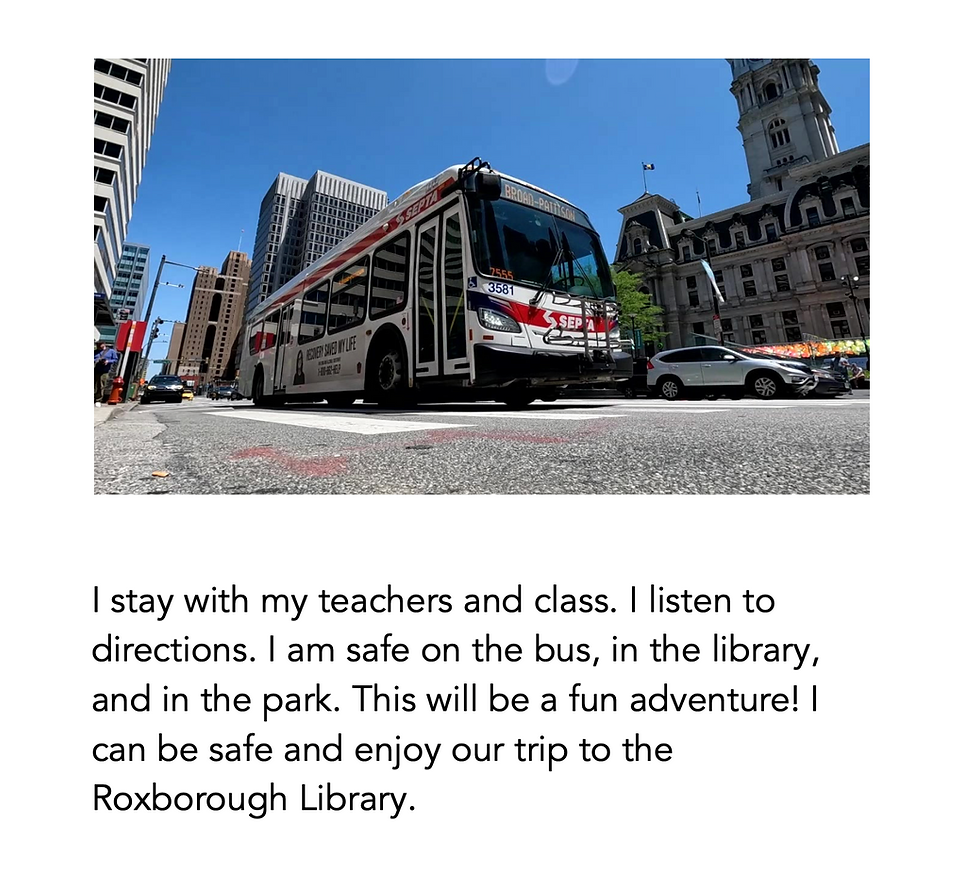
You don’t need anything fancy. Simple materials and thoughtful language are enough.
A few tips that work well for us:
Print stories in half-size so they’re easy for children to handle
Laminate them for durability
Put pages on a metal ring so children can flip through independently
Use short, positive, first-person sentences
Check out a copy of our Field Trip social story on Google Drive where you can edit it for your own needs.
Sample kid-friendly narration:
“I sit on the bus so I can be safe.”
“I keep my hands to myself.”
“I can feel mad, and I can take a breath.”
“I can say goodbye to my grown-up. They come back.”
“I wash my hands to keep my body healthy.”
We avoid corrective or judgment-heavy language and focus instead on what the child can do. The goal isn’t compliance—it’s understanding.
Social stories aren’t about managing behavior. They’re about honoring the child’s need to understand their world. When we take the time to orient children to new experiences—again and again—we’re teaching them that their environment is predictable, their feelings make sense, and they are capable of navigating what comes next.
And that quiet confidence is exactly what Montessori hoped for children.


Comments